
The Science Legacy of Sir Harold Kroto
Today marks the 10th anniversary of the death of Harry Kroto, a scientist whose discovery of buckminsterfullerene (C₆₀), launched modern nanotechnology research. With Robert Curl and Richard Smalley he identified the football shaped molecule made up of 60 carbon atoms and shared with them the chemistry Nobel prize 30 years ago. This work paved the way for carbon nanotubes and then graphene. But beyond his scientific achievements, he was a passionate advocate for science education and gave a lot of his expertise and energy promoting awareness, appreciation and understanding of science particularly to young people from disadvantaged backgrounds.
He gave great encouragement to Calmast in our early days recognising a shared mission of promoting curiosity, creativity and critical thinking. In 2005, he visited Waterford to talk to our students and children from local schools.
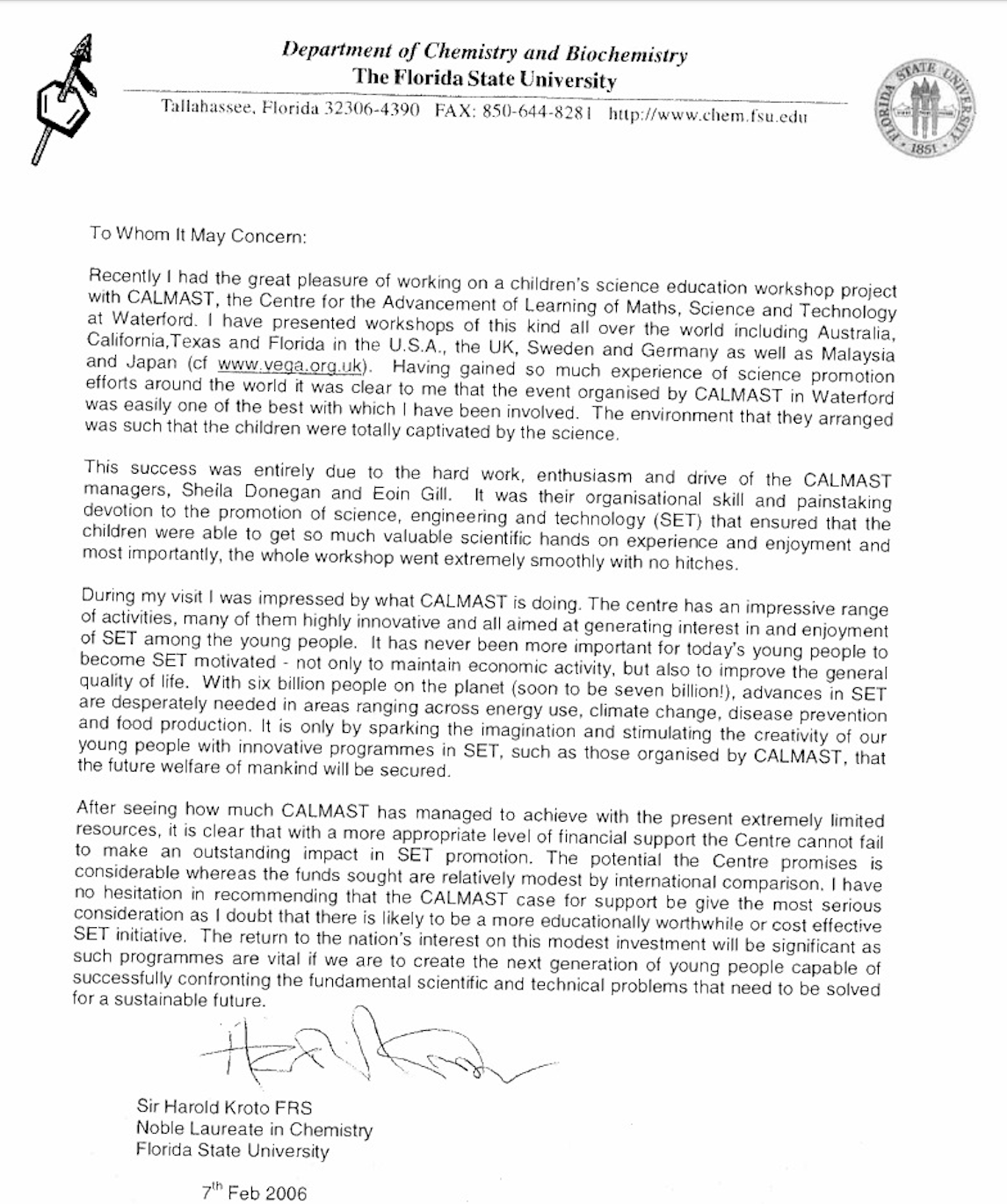
“It was [Calmast’s] organisational skill and painstaking devotion to the promotion of science, engineering and technology (SET) that ensured that the children were able to get so much valuable scientific hands on experience and enjoyment and most importantly, the whole workshop went extremely smoothly with no hitches.”
Speaking in the Irish Times in 2005, he warned that “Science and technology are moving ahead very fast, but we are not developing social responsibility at the same pace. We are producing extremely powerful technologies and it seems to me that we still have a lot to learn about how to interact and how to get on with each other.”


Read Harry Kroto’s testimonial of Calmast HERE.